Table of Contents
This week, Mark Zuckerberg takes the stand in a historic trial examining the impact of social media on children, a moment that could reshape the future of platforms like Instagram and YouTube.
Inside a packed Los Angeles courtroom, the CEO of Meta faced intense questioning about whether Instagram was intentionally designed to keep young users hooked. Seated just feet away was the young woman at the center of the lawsuit — a now 20-year-old plaintiff known publicly as Kaley — who claims she was drawn into compulsive social media use as a child and suffered lasting mental health harm as a result.
Zuckerberg, testifying before a jury for the first time in this long-running legal battle, defended his company’s approach. He told jurors that he believes Meta has handled youth safety “in a reasonable way,” insisting the company carefully weighed research and feedback from experts when shaping its policies.
But outside the courthouse, a very different story unfolded.
Parents Speak Out Against Big Tech



Before proceedings began, nearly a dozen parents gathered outside the Los Angeles Superior Court. Many traveled from across the country, saying their children had been harmed — and in some cases lost — due to social media.
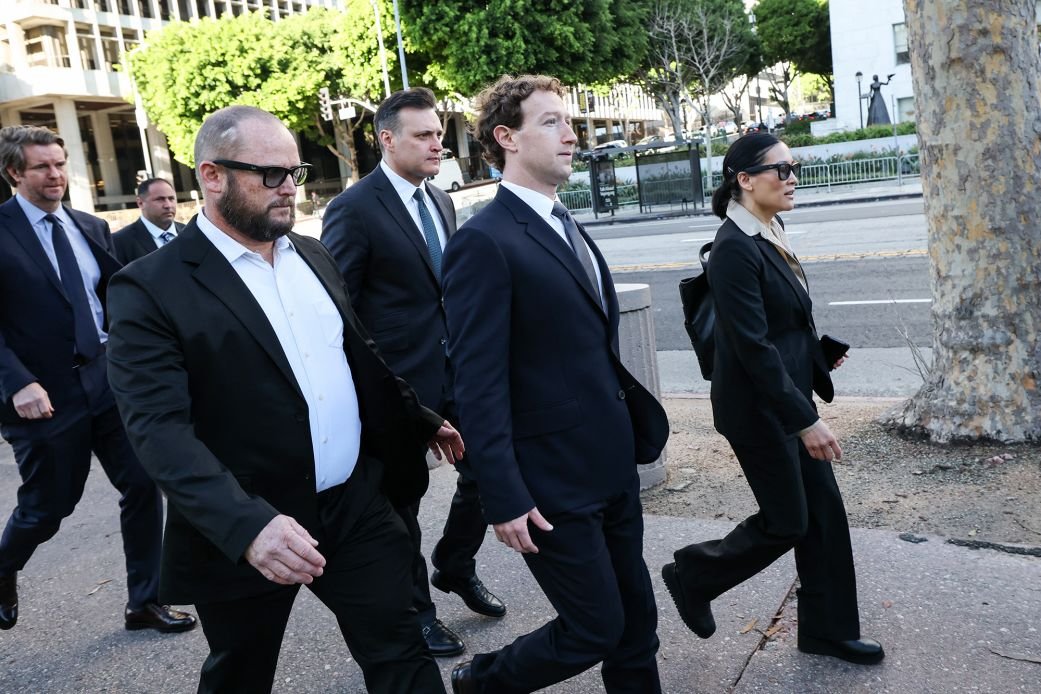
As Zuckerberg entered through the front doors around 8:30 a.m., he passed a crowd of grieving parents and members of the media. When asked what message he had for families who blame social platforms for their children’s suffering, he did not respond.
Among the parents was Julianna Arnold, who attributes the death of her 17-year-old daughter, Coco, to experiences on Instagram. Seeing Zuckerberg testify, she said, felt surreal after years of pleading for stronger protections.
“The intention of the company was to prey on teens,” Arnold told reporters during a break. “That wasn’t an accident. That was for profit.”
Their presence underscored what is at stake. This is not just one lawsuit — it could influence hundreds of similar cases nationwide.
A Case That Could Set a National Precedent
At the heart of the trial is Kaley’s claim that Instagram and YouTube built features designed to encourage addiction-like behavior in children. If a jury agrees, the financial consequences for tech giants could reach billions of dollars — along with sweeping changes to how platforms operate.
Kaley’s attorney, Mark Lanier, argued that she began using Instagram at just nine years old. He presented evidence that she sometimes spent hours — even more than 16 hours in a single day — scrolling and posting. According to the lawsuit, this intense engagement contributed to anxiety, body dysmorphia, suicidal thoughts, bullying, and even sextortion.
During cross-examination, Lanier introduced a striking visual: a long poster displaying hundreds of Kaley’s Instagram photos, held up by multiple people in the courtroom. The display was meant to illustrate what he described as compulsive usage patterns.
Meta has firmly denied these claims. A company spokesperson stated that Meta strongly disagrees with the allegations and believes evidence will show its longstanding commitment to youth safety. The defense has also argued that Kaley’s mental health struggles stemmed primarily from difficult personal circumstances unrelated to social media.
Debate Over Age Policies and Platform Access
One of the most pointed exchanges focused on Instagram’s age restrictions.
Technically, users must be at least 13 years old to sign up. Zuckerberg testified that children under 13 are “not allowed on Instagram.” However, Lanier introduced a 2015 internal document estimating that more than four million Instagram users were under 13 at the time — representing roughly 30% of American children aged 10 to 12.
It wasn’t until late 2019 that Instagram began requiring new users to enter their birthdate during registration. Existing users were prompted for age verification in 2021 as part of expanded youth safety efforts.
That timeline is central to Kaley’s case, as she was never asked for her age when she joined.
Zuckerberg acknowledged that privacy concerns initially complicated stricter verification measures but said the company ultimately arrived at the right policy.
Time Spent vs. “Utility and Value”
Another tense moment arose when Lanier questioned whether Meta once set internal goals to increase time spent on Instagram.
Zuckerberg admitted that early company plans included engagement growth targets. An internal 2015 email referencing a three-year strategy included a goal of boosting Instagram time by 10%. However, he argued that Meta later shifted its focus away from time-based metrics and toward “utility and value.”
“There’s a basic assumption I have,” Zuckerberg said, “that if something is valuable, people will use it more.”
He emphasized that his aim has always been to create products with long-term appeal — not tools that exploit short-term psychological vulnerabilities.
Filters, Free Expression, and Mental Health
The courtroom also examined Instagram’s “beauty” filters, which alter facial features to simulate makeup or cosmetic enhancements.
Lanier claimed Meta consulted experts who warned such filters could harm young users’ self-image. Instagram ultimately allowed user-created filters but chose not to actively promote them.
Zuckerberg defended that decision as a balance between free expression and safety. While acknowledging expert input, he said he believed users should have creative freedom, provided the company did not directly design or push potentially harmful effects.
Profits, Responsibility, and the Jury’s Role
Legal analysts suggest the outcome may hinge less on technical details and more on perception. Kimberly Pallen, a civil litigation specialist, noted that jurors will likely consider whether Meta appears to be genuinely trying to protect young users — or prioritizing profits.
Zuckerberg also addressed his majority ownership stake in Meta, explaining that company success fuels investment in science and research. He reiterated his pledge to donate 99% of his wealth over time. When pressed about pledging money specifically for alleged victims of social media, he pushed back, rejecting the framing of the question.
A Turning Point for Big Tech
As Mark Zuckerberg takes the stand in a historic trial examining the impact of social media on children, the proceedings represent more than one executive’s testimony. They signal a broader reckoning for an industry that has transformed how young people connect, communicate, and see themselves.
For families seeking accountability, this trial is about acknowledgment and reform. For Meta and other platforms, it is about defending innovation and intent.
When Zuckerberg left the courthouse through a back exit after more than five hours on the stand, the legal battle was far from over. But one thing is clear: the verdict could reshape the rules of the digital world — and redefine how responsibility is assigned in the age of social media.