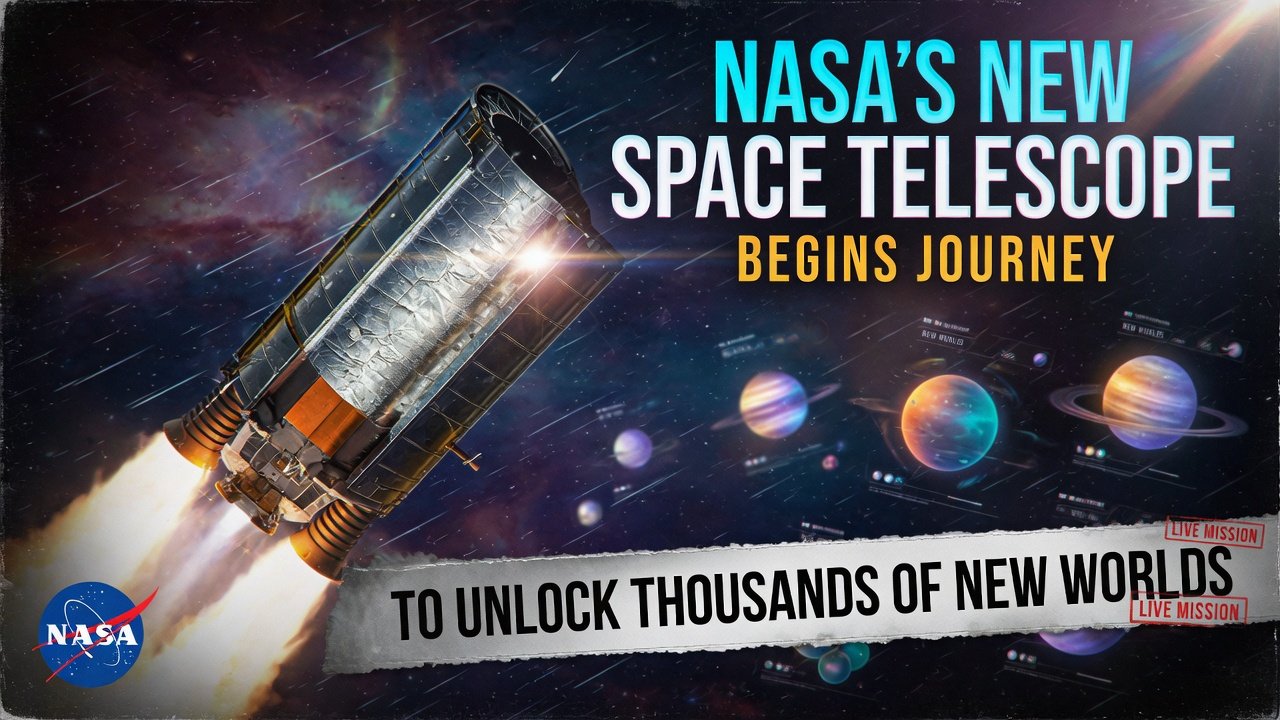
NASA’s New Space Telescope Begins Million-Mile Journey to Explore the Universe
NASA’s New Space Telescope, the Nancy Grace Roman Space Telescope, has officially begun its journey into deep space after launching aboard a SpaceX Falcon Heavy rocket on August 30, 2026.
The observatory lifted off at 7:26 a.m. EDT from Launch Complex 39A at NASA’s Kennedy Space Center in Florida and is now traveling toward the second Sun-Earth Lagrange point, known as L2, roughly 1 million miles from Earth.
The mission is designed to transform how scientists survey the universe, with a wide-field infrared camera capable of observing enormous portions of the sky while investigating dark energy, dark matter and planets beyond our solar system.
NASA’s Roman Telescope Has Already Launched
The original description of the mission as an upcoming launch is now outdated.
NASA successfully launched the Nancy Grace Roman Space Telescope on August 30, 2026. The spacecraft separated from the Falcon Heavy’s second stage shortly after liftoff and began its approximately three-month journey toward L2.
Once it reaches its destination and completes commissioning, Roman is expected to begin one of the most ambitious astronomical surveys ever conducted.
NASA anticipates releasing Roman’s first images in early 2027 after the telescope completes deployment, calibration and testing.
Why Roman Is Being Sent One Million Miles Away
Roman will orbit near the second Sun-Earth Lagrange point, approximately 1 million miles from Earth.
At L2, the combined gravitational effects of the Sun and Earth allow the spacecraft to maintain a relatively stable position while following Earth’s orbit around the Sun.
This location also provides Roman with a stable observing environment and helps keep the Sun, Earth and Moon from interfering with its observations.
Roman will share the general L2 region with NASA’s James Webb Space Telescope, although the two observatories have different missions and instruments.
Roman’s Wide-Field Camera Is the Big Advantage
One of the most important features of NASA’s New Space Telescope is its Wide Field Instrument.
The instrument is a 300-megapixel infrared camera designed to capture a much larger area of the sky than Hubble while maintaining similar image sharpness.
NASA says Roman’s field of view will be at least 100 times larger than Hubble’s in a single pointing. A NASA budget document also describes Roman’s field of view as 200 times greater than Hubble’s infrared instrument, which explains the larger comparison sometimes cited for the mission.
The key advantage is therefore not simply higher magnification. Roman is designed to survey huge sections of the universe quickly.
Roman Could Discover Around 100,000 Exoplanets
Exoplanet discovery is one of the mission’s major scientific goals.
NASA expects Roman to conduct a statistical census of planetary systems in the Milky Way and potentially discover roughly 100,000 new exoplanets.
The telescope will use gravitational microlensing among its techniques for finding distant planets.
When a planet passes in front of a distant star from our viewpoint, its gravity can temporarily magnify the star’s light. By carefully monitoring these changes, astronomers can identify planets that might otherwise be extremely difficult to detect.
NASA says Roman’s microlensing survey is expected to find more than 1,000 exoplanets as part of its primary science program.
Roman Will Look at Billions of Galaxies
The telescope’s ambitions extend far beyond planets.
Roman will survey billions of galaxies and generate enormous amounts of astronomical data. Scientists will use those observations to investigate how galaxies formed and evolved and to better understand the structure of the universe.
The mission is also designed to address some of the biggest questions in modern cosmology, particularly the nature of dark matter and dark energy.
NASA says Roman will survey the universe roughly 1,000 times faster than Hubble while maintaining similar sensitivity and infrared resolution.
Understanding Dark Energy
One of Roman’s central objectives is investigating why the expansion of the universe appears to be accelerating.
Scientists refer to the unknown component driving this acceleration as dark energy, but its underlying nature remains one of the biggest unanswered questions in physics.
By observing huge numbers of galaxies, supernovae and other cosmic objects, Roman will provide researchers with an enormous dataset for studying the history and expansion of the universe.
Roman Will Also Study Dark Matter
Dark matter is another major target.
Although dark matter cannot be observed directly through visible light, its gravitational effects influence galaxies and the large-scale structure of the universe.
Roman’s wide-field surveys will help astronomers map these effects across enormous areas of the sky.
Combining Roman’s observations with data from other telescopes could give scientists a clearer picture of how dark matter is distributed and how it influenced the formation of cosmic structures.
A New Tool for Directly Imaging Exoplanets
Roman also carries the Coronagraph Instrument, a technology demonstration designed to test techniques for directly imaging planets orbiting other stars.
The instrument can block or suppress starlight, making it easier to detect faint objects located close to bright stars.
NASA says the coronagraph will demonstrate technology that could contribute to future missions such as the proposed Habitable Worlds Observatory, which is intended to search for potentially habitable planets and signs of life.
Roman Will Produce Huge Amounts of Data
The telescope’s enormous survey capability will come with an equally enormous flow of information.
NASA says Roman is expected to transmit about 1.4 terabytes of data every day, making it the highest data-rate astrophysics mission NASA has operated so far.
Artificial intelligence, machine learning and citizen scientists will help researchers process the huge volume of observations and identify objects or events that deserve closer examination.
This could allow astronomers to discover unexpected phenomena that were not necessarily part of Roman’s original mission objectives.
Roman and Hubble Have Different Strengths
Roman is not designed simply to replace Hubble.
Hubble has played a historic role in producing detailed observations of individual astronomical objects and regions of space.
Roman, by contrast, is designed to survey much larger areas rapidly.
NASA describes Roman as having a field of view at least 100 times larger than Hubble’s while maintaining similar angular resolution. That combination means a single Roman image can contain a huge amount of information about the surrounding universe.
The two observatories can therefore complement one another, with Roman identifying interesting targets across enormous regions that other telescopes can later study in greater detail.
When Will Roman Start Sending Scientific Images?
Roman’s journey to L2 will take approximately three months.
After reaching its destination, NASA will conduct an extensive commissioning process involving instrument activation, calibration and testing.
NASA currently expects Roman’s first images to be released in early 2027.
The mission has a planned primary lifetime of about five years, with NASA’s technical documentation identifying a longer-term goal of up to 10 years.
Why This Mission Matters
NASA’s New Space Telescope could fundamentally expand the amount of the universe scientists can study at once.
Instead of concentrating primarily on individual targets, Roman will repeatedly survey enormous regions of the sky, creating a massive astronomical dataset that can be analyzed for years.
Its combination of infrared imaging, wide-field coverage and rapid surveying could produce discoveries extending from nearby planetary systems to the earliest stages of galaxy formation.
For exoplanet researchers, the potential discovery of tens of thousands of previously unknown worlds could dramatically expand our understanding of how common different types of planetary systems are.
Key Takeaway
NASA’s New Space Telescope, the Nancy Grace Roman Space Telescope, has now launched and is traveling toward its million-mile destination at L2.
With a Wide Field Instrument at least 100 times wider than Hubble’s field of view and the potential to uncover around 100,000 exoplanets, Roman is designed to survey the universe on a scale that previous space telescopes could not match.
The telescope’s first images are expected in early 2027, but its scientific impact could continue for years as astronomers use its enormous archive to investigate planets, galaxies, dark matter and dark energy.
FAQs
1. What is NASA’s New Space Telescope?
NASA’s New Space Telescope is the Nancy Grace Roman Space Telescope, a wide-field infrared observatory designed to study dark energy, dark matter, exoplanets and the evolution of the universe.
2. Has the Nancy Grace Roman Space Telescope launched?
Yes. Roman launched on August 30, 2026, aboard a SpaceX Falcon Heavy rocket from NASA’s Kennedy Space Center.
3. How far from Earth will Roman orbit?
Roman will operate around the Sun-Earth L2 point, approximately 1 million miles from Earth.
4. How much larger is Roman’s field of view than Hubble’s?
NASA says Roman’s field of view is at least 100 times larger than Hubble’s. Its comparison with Hubble’s infrared instrument can reach about 200 times greater.
5. How many exoplanets could Roman discover?
NASA estimates that Roman could uncover roughly 100,000 new exoplanets, while its dedicated microlensing survey is expected to identify more than 1,000 exoplanets.
6. What is Roman’s main camera?
Roman’s primary instrument is the Wide Field Instrument, a 300-megapixel infrared camera designed to survey enormous areas of the sky.
7. Will Roman replace Hubble?
No. Roman and Hubble are designed for different strengths. Roman will conduct much wider surveys, while Hubble remains valuable for detailed observations of individual cosmic targets.
8. What will Roman study besides exoplanets?
Roman will investigate dark energy, dark matter, galaxies, black holes, stars and the evolution of the universe.
9. When will Roman’s first images be released?
NASA currently anticipates releasing Roman’s first images in early 2027 after its commissioning and instrument testing are completed.
10. Why is the Roman Space Telescope important?
Roman will allow scientists to survey huge portions of the universe much faster than previous space telescopes, potentially revealing thousands of new worlds and providing new evidence about some of the biggest mysteries in modern astronomy.
- Pentagon Uses Polygraph Tests on 50 Joint Staff Members in Classified Leak Hunt
- Russia announces it has restricted access to WhatsApp as part of a broader crackdown on social media platforms
- Apple Watch Privacy Debate: New Audio Features Raise Concerns Over Conversation Listening
- The Unsung Heroes Powering India’s AI Boom: Manas Bhasin & Aditya Singhal