Table of Contents
For much of the past year, the narrative around artificial intelligence in China has been one of speed, scale, and startling ambition. Eye-catching product launches, billion-dollar listings, and rapid adoption across industries have fueled the impression that Chinese AI companies are closing the gap with Silicon Valley — if not preparing to leap ahead.
But behind the headlines, some of the country’s top AI leaders are offering a far more cautious assessment.
A Reality Check in Beijing
When leading Chinese AI executives convened in Beijing earlier this year, the central question was straightforward: Could a Chinese company overtake American AI leaders within the next three to five years?
The answer from Justin Lin, technical lead of the Qwen models at Alibaba, was blunt. He estimated the probability at less than 20 percent — and even that, he said, might be overly optimistic.
His remarks stood in sharp contrast to a year filled with celebratory coverage of China’s AI surge. Since the rise of DeepSeek, which stunned observers with a high-performing model reportedly developed at a fraction of US costs, Chinese firms have dominated open-model downloads and drawn significant investor enthusiasm.
Yet Lin’s perspective was not isolated. Tang Jie, founder of Z.ai (also known as Zhipu), acknowledged that the performance gap between Chinese and US frontier models may actually be widening.
China may be advancing rapidly, but that doesn’t necessarily mean it’s catching up at the very top of the AI hierarchy.
The Open-Source Strategy: China’s Competitive Pivot
If there is one defining feature of China’s AI approach, it is its aggressive embrace of open-source models.
Faced with restricted access to advanced semiconductors and tighter capital markets, Chinese firms have leaned heavily into releasing AI systems for public use. Rather than guarding intellectual property behind closed systems, they have prioritized rapid distribution and ecosystem growth.
This strategy differs from many American giants. While Meta made early waves with its open Llama models, most major US firms — including OpenAI, Google, and Anthropic — have focused on closed, proprietary systems.
The impact of China’s approach has been significant:
Chinese open models have surged in global adoption.
Alibaba has released hundreds of Qwen variants, generating massive download numbers.
Companies are embedding AI into manufacturing, logistics, e-commerce, robotics, and customer service at remarkable speed.
Even Western companies have taken notice. Platforms like Airbnb have experimented with Chinese-developed models for customer support solutions. Meanwhile, Meta announced plans to acquire Manus, an AI agent startup founded in China, signaling global recognition of the country’s technical progress.
Open sourcing, analysts say, offers China two strategic advantages: lower costs and reduced geopolitical vulnerability. If sanctions were to expand, products built on open frameworks could still circulate independently of the originating company.
But there is also a pragmatic explanation. In China’s market, consumers and enterprises have historically been reluctant to pay high subscription fees for software. Open models create scale first — monetization comes later.
Chips, Capital, and the Performance Gap
Despite the open-source boom, structural constraints remain.
Washington’s export controls have restricted Chinese access to cutting-edge chips from Nvidia, including its latest Blackwell and Rubin series GPUs. Although older-generation chips such as the H200 have received conditional approvals, supply volume remains limited.
High-end AI research depends on massive computational resources. American firms like OpenAI and Anthropic continue to pour enormous compute power into next-generation systems. Chinese developers, by contrast, must stretch more constrained hardware resources.
Capital dynamics add further pressure. US startups often secure multiple large funding rounds before going public. Chinese AI companies, facing a thinner venture capital environment and growing expectations for near-term revenue, have turned to public listings earlier in their lifecycle.
This urgency can accelerate commercialization — but it can also limit long-term research risk-taking.
As a result, while Chinese models perform strongly in open ecosystems, proprietary US systems such as GPT, Gemini, and Claude still dominate top-tier performance benchmarks.
Industrial Integration: China’s Hidden Strength
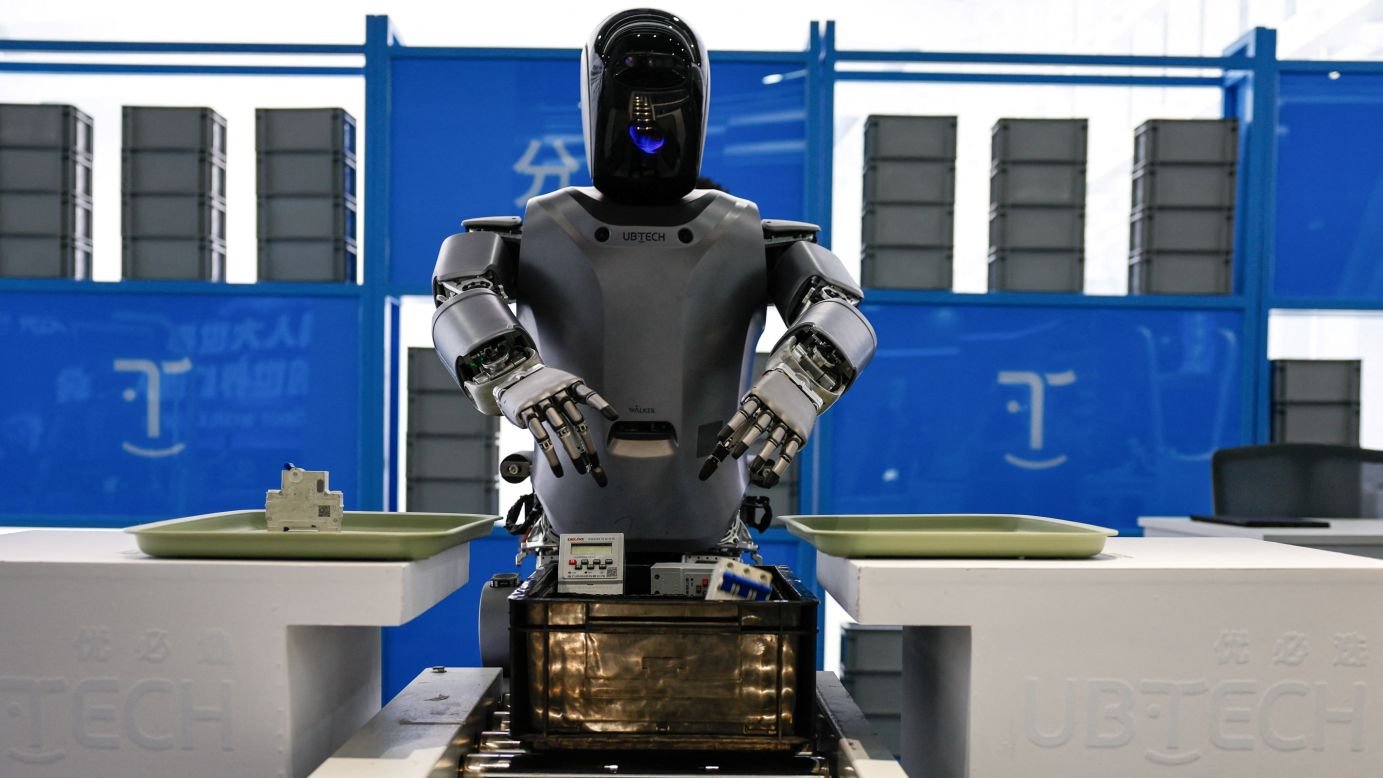
Where China may hold a strategic edge is not necessarily in frontier research — but in deployment.
The country’s manufacturing ecosystem and digital infrastructure allow rapid integration of AI into real-world processes. From factory automation to smart logistics networks, AI is being embedded deeply across industrial layers.
Beijing has reinforced this push through national policy initiatives aimed at accelerating AI use in manufacturing and upgrading traditional industries.
Researchers note that even if Chinese models are not always the global best, they are becoming pervasive. The industrialization of AI — turning models into scaled, revenue-generating systems — is progressing at impressive speed.
This mirrors earlier patterns in sectors such as electric vehicles and advanced manufacturing, where China scaled quickly and eventually became globally competitive.
The Cultural Question
Some insiders argue that the bigger hurdle may not be hardware or capital — but mindset.
China produces abundant AI talent, and its engineers have repeatedly demonstrated the ability to replicate and refine Western innovations at remarkable speed. But creating entirely new paradigms — rather than iterating on existing ones — requires a strong culture of risk-taking and tolerance for failure.
That may prove to be the defining challenge in determining whether China can truly lead rather than follow.
So, Is China Unstoppable?
The excitement is understandable. The pace of releases, IPO activity, and ecosystem growth makes it tempting to believe that China’s AI sector appears unstoppable in its race to outpace US competitors — but is that really the case?
The answer is more nuanced.
China is advancing quickly, especially in open-source adoption and industrial integration. Its companies are resourceful, pragmatic, and increasingly global in ambition.
Yet frontier model leadership still favors the United States, largely due to superior access to compute power, capital depth, and research intensity.
Rather than a decisive overtake in the next few years, the more likely outcome may be sustained competition — with China narrowing gaps in some areas while forging its own distinctive AI path in others.
The race is far from over. And if history is any guide, the real story may not be who leads today — but who adapts fastest tomorrow.