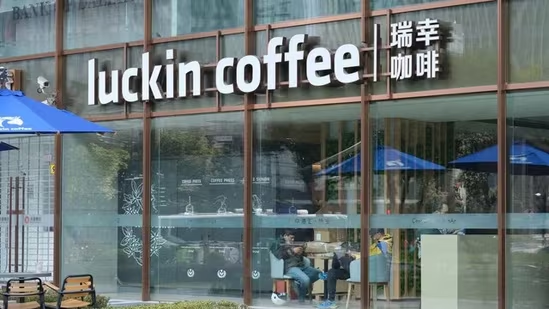
Luckin Coffee opens its first upscale outlet in China, challenging Starbucks’ dominance — and it’s doing so with a statement-making flagship store designed to reshape how consumers view the once budget-focused brand.
China’s largest coffee chain has officially stepped into the premium arena with the launch of its two-story Luckin Coffee Origin Flagship in Shenzhen, a city bordering Hong Kong and known for setting lifestyle trends. The new store marks a clear shift from Luckin’s original playbook of low-cost, grab-and-go kiosks that helped it surpass Starbucks in total store count across China.
A Strategic Shift From Budget to Boutique
For years, Luckin built its empire on affordability, selling Americanos and lattes for roughly $1 to $2 and relying heavily on app-based ordering. That strategy worked — spectacularly. But the Shenzhen flagship signals that Luckin is now aiming higher, both in price and perception.
The 420-square-meter (4,521-square-foot) store offers pour-over and cold brew options at slightly elevated prices, along with single-origin beans sourced from Brazil, Ethiopia, and China’s Yunnan province. This “origin” theme mirrors the premium storytelling Starbucks has long used to justify higher price points and cultivate brand loyalty.
Customers can also find more elaborate specialty drinks, including a tiramisu latte topped with an actual pastry. According to posts on the Chinese social media platform Xiaohongshu, demand has been intense, with early visitors reporting wait times of one to three hours following the store’s soft launch on January 20.
Pressure Mounts on Starbucks in a Crowded Market
The opening underscores how fiercely competitive China’s coffee market has become. Starbucks once dominated the premium space, even choosing Shanghai for its second-ever Reserve Roastery megastore in 2017, after Seattle. But as coffee culture has grown in what was traditionally a tea-drinking country, Starbucks has faced mounting pressure from boutique cafés and fast-growing domestic chains such as Manner and Cotti Coffee — many of which sell drinks at half Starbucks’ prices.
That pressure comes at a time when Starbucks is rethinking its China strategy. The U.S.-based company is in the process of selling a 60% stake in its China business to Boyu Capital, while retaining 40%. When announced last November, the deal valued Starbucks’ China operations at about $13 billion, including future licensing fees.
Luckin’s Financial Comeback Gains Momentum
Luckin’s premium push comes after a dramatic turnaround. Once mired in a 2020 accounting scandal that led to its delisting from the Nasdaq, the company has rebuilt its business and reputation at remarkable speed.
For the three months ended September 30, 2025, Luckin reported $1.55 billion in revenue — a nearly 48% increase from a year earlier — driven largely by its self-operated stores, which make up the majority of its China footprint. The Shenzhen flagship is being promoted as Luckin’s 30,000th store, with total global locations standing at 29,214 as of the end of September.
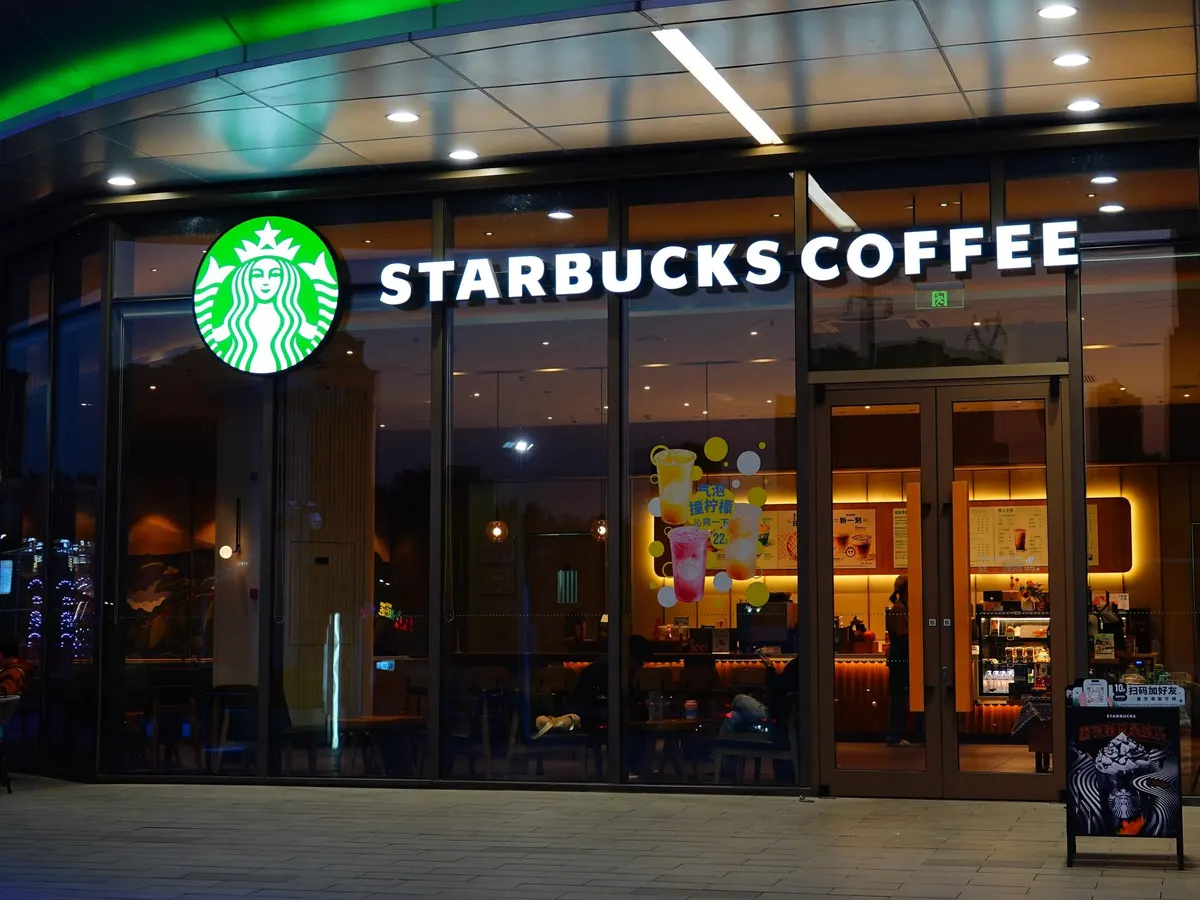
By comparison, Starbucks operates just over 8,000 stores in China and about 16,900 in the U.S., its largest market. Starbucks reported China net revenue of $831.6 million for the quarter ended September 28, up 6% year over year, with comparable same-store sales improving toward the end of the year.
Luckin, whose shares still trade over the counter in the U.S., had a market capitalization of roughly $10.46 billion as of Thursday.
Re-Listing Hopes and Brand-Building Tactics
Late last year, Luckin CEO Jinyi Guo hinted that the company may pursue a U.S. re-listing, though no timeline was disclosed. Founded in 2017, Luckin skyrocketed to a $2.9 billion valuation within 18 months before its rapid fall — and equally notable recovery.
Part of that recovery has been driven by savvy marketing collaborations. Luckin has partnered with brands and pop culture icons ranging from premium liquor maker Moutai to the Minions and the hit video game Black Myth: Wukong, often capitalizing on viral moments to drive traffic and buzz.
According to Mingchao Xiao, founder of Zhimeng Trends Consulting, Luckin’s real competitive edge lies in its app-based ecosystem. By encouraging customers to order and pay through their smartphones rather than at a counter, Luckin has built a powerful pool of private user traffic and gained valuable consumer data.
Looking Beyond China
Luckin’s ambitions are no longer confined to the domestic market. Last summer, the company opened its first U.S. locations in New York City and marked its 10th store there on February 6. It has also expanded steadily across Southeast Asia, with 68 stores in Singapore and 45 jointly operated outlets in Malaysia.
As younger Chinese consumers seek not just caffeine but experiences and emotional connection, Luckin appears determined to meet them where they are — even if that means taking on Starbucks on its own premium turf.
- I studied over 200 children, and the happiest among them all had parents who followed six nightly routines
- Ensuring effective AI in insurance operations
- Research finds UK young adults are open to using AI for financial advice
- NHK projects Japan’s ruling LDP, led by Prime Minister Takaichi, to secure an outright majority in the snap election